Connect with us

News

FG never gave N570 billion to 36 States – Seyi Makinde counters President Tinubu

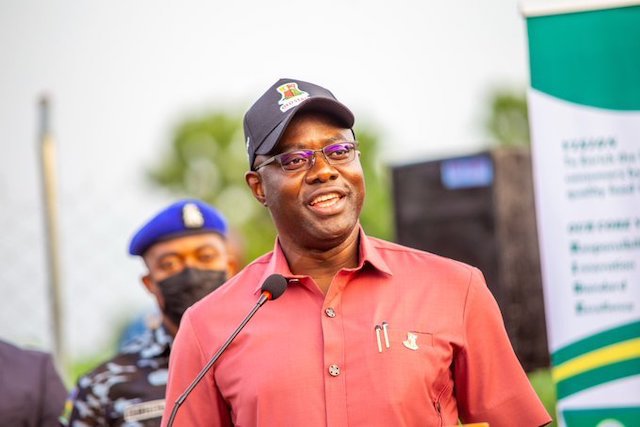
Following President Bola Tinubu’s announcement that his administration has given a total sum of N570 billion to the 36 states as a palliative measure to ease the citizens’ economic condition, Oyo State Governor Seyi Makinde has come out to say the President’s comments are not accurate.

Tinubu made this statement while addressing the nation last Sunday, appealing that
those protesting halt their demonstration and return to the negotiation table.

According to the president, the State received this huge sum as a grant from the
federal government.

He said, “Also, more than N570 billion has been released to the 36 states to expand
livelihood support to their citizens, while 600,000 nano-businesses have benefitted
from our nano-grants. An additional 400,000 more nano-businesses are expected to
benefit.”

Oyo State Governor, Seyi Makinde, has countered claims by President Tinubu. In a newsletter signed by the governor and published on the state’s official website on
Thursday, Makinde said the funds disbursed were not a direct allocation from the
federal government.

The governor clarified that the money received by the states was World
Bank COVID-19 funds, with the federal government acting only as an intermediary
between the international creditor and the 36 states.

He further explained that the funding was contingent on what the states had already
spent on COVID-19 programs, meaning the World Bank was simply reimbursing what
the states had used to address the pandemic crisis.

The Statement read as follows:

“Before I speak more on further actions we have taken to show our commitment to
productivity and sustainability, let me respond to a long message I received earlier in
the week from a concerned citizen. The message was about a purported N570 billion Hardship Fund “given” to the 36 States by the Federal Government. I was queried about what I used the money for. Let me state categorically that this is yet another case of misrepresentation of facts. The said funds were part of the World Bank-assisted NG-CARES project—a Program for Results Intervention. The World Bank facilitated an intervention to help States in Nigeria with COVID-19 Recovery. CARES means COVID-19 Action Recovery Economic Stimulus.

“It was called Programme for Results because States had to use their money in
advance to implement the program. After the World Bank verified the amount
spent by the State, it reimbursed the States through the platform provided at the
Federal level. The Federal Government did not give any State money; they were simply the
conduit through which the reimbursements were made to States for money already
spent,” Makinde said.

According to Makinde, the funding from the World Bank that was given to the state was not
a grant, but a loan that is expected to be paid back by each state.
He said the NG-Cares loan, as it is dubbed, predates Tinubu’s administration as the
facilities were received in different batches.
According to him, Oyo State received N5.98 billion in the first instance and N822
million in the second instance as reimbursement which was part of the investment of
the State government under the program.
“It is important to note that the World Bank fund is a loan to States, not a grant. So,
States will need to repay this loan. Note also that NG-CARES, which we christened
Oyo-CARES in our State predates the present federal administration.
So, in direct response to the message, the Federal Government did not give Oyo
State any money. We have reimbursed funds (N5.98 billion in the first instance and
N822 million in the second instance) we invested in the three result areas of NGCARES, which includes inputs distribution to smallholder farmers within our State”
When the World Bank saw our model for the distribution of inputs preceded
by biometric capturing of beneficiary farmers, they adopted it as the NG-CARES
model,” Makinde added.

Click to comment

Leave a Reply

Your email address will not be published. Required fields are marked *

Entertainment

Kanayo O. Kanayo demands lifetime streaming royalties for Nollywood stars

Veteran Nollywood actor Kanayo O. Kanayo has stirred up a conversation the industry has been quietly avoiding for years. The award-winning actor and lawyer recently proposed that the Actors Guild of Nigeria (AGN) implement a policy mandating lifetime royalty payments for all Nigerian actors and actresses featured in films uploaded to streaming platforms.

He also called for a dedicated agency to oversee and enforce compliance nationwide, arguing it would ensure performers earn from their craft long after the cameras stop rolling. The timing of the proposal is telling. Stories of financial ruin among once-beloved Nigerian actors have become alarmingly common.

Last month, veteran actor Abiodun Ayoyinka, widely known as Papa Ajasco, spoke openly about his financial struggles despite decades in the industry.

Two years prior, Hanks Anuku made headlines with public pleas for financial assistance after falling on hard times post-Nollywood.

Patience Ozokwor recently put it bluntly: “The reason why Nollywood actors and actresses are poor is that we don’t get royalties for what we do, we only get paid for our appearance at the shoot.” Her words, along with the others, show a consistent pattern of demand.

The proposal has drawn mixed reactions from industry figures. Writer-director Jadesola Osiberu responded with sarcasm, suggesting that if actors want royalties, perhaps they should also contribute to covering a producer’s losses proportional to their screen time, a dig at the one-sided nature of the demand.

Producer and actress Bolaji Ogunmola was more direct: if actors want backend earnings, they should negotiate equity stakes and invest in projects upfront rather than seek guaranteed payouts after the fact.

It’s a fair challenge. The music industry comparison many have reached for doesn’t quite hold up here.

In more structured film industries, residuals are tied to carefully negotiated distribution contracts and enforced by unions, organisations built over decades with legal infrastructure and industry-wide buy-in.

Continue Reading

News

Katsina plans mass wedding for 1,000 couples

The state government’s maiden welfare initiative will unite 2,000 individuals on April 25, even as armed bandits terrorise nearby communities. The Katsina State Government has announced a mass wedding ceremony for at least 1,000 couples drawn from all 34 local government areas, describing the initiative as a bid to ease the financial burden of marriage on the state’s most vulnerable residents.

The event, scheduled for April 25, 2026, will bring together 2,000 individuals, including widows, orphans, and economically disadvantaged people who, officials say, have long been willing to marry but unable to afford it.

The Director General of the Katsina State Hisbah Board, Malam Abu-Ammar, announced a livelihood support and counselling training session on Thursday.

He said the programme was conceived as part of the government’s efforts to reduce conditions that breed social vices.

“Many widows, orphans, and vulnerable individuals are unable to get married despite their willingness due to socioeconomic challenges,” he said.

The Katsina State Commissioner for Women Affairs, A’isha Malumfashi, added that all 1,000 couples had already undergone medical screening and compatibility verification ahead of the ceremony.

The government has promised support packages for both brides and grooms, though the total budget for the event has not been disclosed.

The announcement, however, comes at a fraught moment for the state. Just hours before it was made public, armed bandits reportedly issued a written ultimatum to communities in Kankia Local Government Area, demanding 700 cows and 1,000 sheep within four days or face violent raids.

Continue Reading

News

Trump threatens 50% tariffs on countries arming Iran

Donald Trump has cautioned that the United States will impose heavy tariffs on any country that is found to supply military weapons to Iran, raising the bar of pressure in the midst of continuing tensions with Tehran.

On Wednesday, in a statement released on his Truth Social platform, Trump stated that any country supplying arms to Iran would be subjected to a 50 percent tariff on all its goods exported to the United States without any delay.

“A country supplying military weapons to Iran will be immediately tariffed on all goods sold to the United States of America, 50 per cent, effective immediately. There will be no exclusions or exemptions,” he wrote.

The warning comes shortly after the U.S. president announced a temporary ceasefire arrangement with Iran following heightened tensions in the region. This happened just hours before the deadline, Donald Trump urged Iran to reopen the Strait of Hormuz. The US President announced a ceasefire facilitated by Pakistan. In a post X, the White House shared that Trump has issued a temporary hold on all military activities in Iran.

President Trump announced that after conversations with Pakistani Prime Minister Shehbaz Sharif and Field Marshal Asim Munir, he will be suspending the bombing and attack on Iran for a period of two weeks after the Iranians agreed to an “immediate and safe opening of the Strait of Hormuz”.

He went ahead and added that the US has already met and exceeded all military objectives and is making progress on a long-term peace agreement with Iran. Trump also said his administration is considering possible economic relief measures for Tehran, noting that Washington is currently engaged in discussions around tariff and sanctions relief.

The developments follow Iran’s reported agreement to temporarily reopen the strategically important Strait of Hormuz, a key global shipping route at the centre of recent geopolitical concerns.

While details of the ceasefire and negotiations remain limited, the latest remarks highlight a mix of economic pressure and diplomatic engagement from Washington as it navigates relations with Tehran.

The series of warnings started in March, when Trump issued one of his most explosive warnings yet to Iran, saying the United States could “completely obliterate” the country’s electric plants, oil wells, and Kharg Island if a deal with a so-called “new and more reasonable regime” fails and the Strait of Hormuz is not reopened.

In a post on social media, Trump claimed the U.S. is in serious discussions with a new Iranian leadership aimed at ending American military operations in the country. However, he warned that failure to reach a deal quickly could prompt devastating military action against Iran’s infrastructure.

Continue Reading

Trending