Connect with us

News

FG never gave N570 billion to 36 States – Seyi Makinde counters President Tinubu

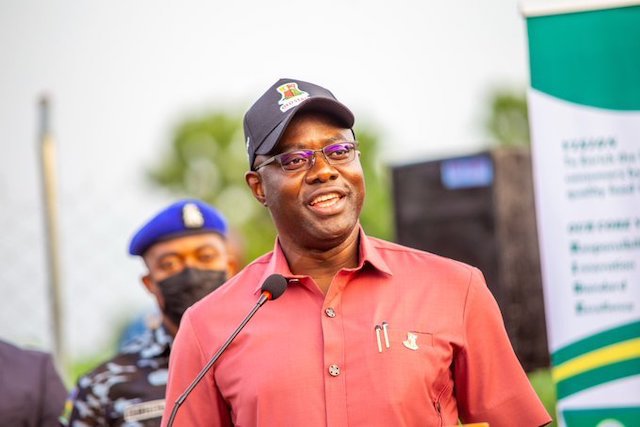
Following President Bola Tinubu’s announcement that his administration has given a total sum of N570 billion to the 36 states as a palliative measure to ease the citizens’ economic condition, Oyo State Governor Seyi Makinde has come out to say the President’s comments are not accurate.

Tinubu made this statement while addressing the nation last Sunday, appealing that
those protesting halt their demonstration and return to the negotiation table.

According to the president, the State received this huge sum as a grant from the
federal government.

He said, “Also, more than N570 billion has been released to the 36 states to expand
livelihood support to their citizens, while 600,000 nano-businesses have benefitted
from our nano-grants. An additional 400,000 more nano-businesses are expected to
benefit.”

Oyo State Governor, Seyi Makinde, has countered claims by President Tinubu. In a newsletter signed by the governor and published on the state’s official website on
Thursday, Makinde said the funds disbursed were not a direct allocation from the
federal government.

The governor clarified that the money received by the states was World
Bank COVID-19 funds, with the federal government acting only as an intermediary
between the international creditor and the 36 states.

He further explained that the funding was contingent on what the states had already
spent on COVID-19 programs, meaning the World Bank was simply reimbursing what
the states had used to address the pandemic crisis.

The Statement read as follows:

“Before I speak more on further actions we have taken to show our commitment to
productivity and sustainability, let me respond to a long message I received earlier in
the week from a concerned citizen. The message was about a purported N570 billion Hardship Fund “given” to the 36 States by the Federal Government. I was queried about what I used the money for. Let me state categorically that this is yet another case of misrepresentation of facts. The said funds were part of the World Bank-assisted NG-CARES project—a Program for Results Intervention. The World Bank facilitated an intervention to help States in Nigeria with COVID-19 Recovery. CARES means COVID-19 Action Recovery Economic Stimulus.

“It was called Programme for Results because States had to use their money in
advance to implement the program. After the World Bank verified the amount
spent by the State, it reimbursed the States through the platform provided at the
Federal level. The Federal Government did not give any State money; they were simply the
conduit through which the reimbursements were made to States for money already
spent,” Makinde said.

According to Makinde, the funding from the World Bank that was given to the state was not
a grant, but a loan that is expected to be paid back by each state.
He said the NG-Cares loan, as it is dubbed, predates Tinubu’s administration as the
facilities were received in different batches.
According to him, Oyo State received N5.98 billion in the first instance and N822
million in the second instance as reimbursement which was part of the investment of
the State government under the program.
“It is important to note that the World Bank fund is a loan to States, not a grant. So,
States will need to repay this loan. Note also that NG-CARES, which we christened
Oyo-CARES in our State predates the present federal administration.
So, in direct response to the message, the Federal Government did not give Oyo
State any money. We have reimbursed funds (N5.98 billion in the first instance and
N822 million in the second instance) we invested in the three result areas of NGCARES, which includes inputs distribution to smallholder farmers within our State”
When the World Bank saw our model for the distribution of inputs preceded
by biometric capturing of beneficiary farmers, they adopted it as the NG-CARES
model,” Makinde added.

Click to comment

Leave a Reply

Your email address will not be published. Required fields are marked *

Celebs

Ayra Starr’s Much Anticipated Album To Drop in 2026

Ayra Starr has sparked a whirlwind of anticipation across the global music landscape. Following her meteoric rise, the Mavin Records superstar and Roc Nation signee has stirred excitement among fans by hinting at her forthcoming project.

Featured in Spotify’s “Our Frequency” zine issue 033, the ‘Celestial Being’ shared insights into her personal and professional aspirations, including a tease that her next album could land in 2026. This disclosure emerged within Spotify’s platform dedicated to celebrating Black artists and their creative narratives, with the recent edition spotlighting Starr’s journey of growth and artistic evolution.

Spotify’s “Our Frequency” initiative offers artists a space to reveal intimate details about their lives and craft. In the Spotify feature, Ayra Starr reflected on her formative years and how diverse environments shaped her distinctive sound and personality.

The 23-year-old drew interesting parallels between cultures, noting that, “Growing up in Benin and Nigeria, it was two different vibes.” She likened the energy of Nigeria’s commercial hub to a global city: “Lagos is almost like New York.”

In stark contrast, the 2026 Grammy nominee described her experience in the Benin Republic: “Benin Republic has more like a beach vibe. Everywhere is, like, calm. Everybody is quiet, so I can’t put it into, like, a few words. It’s made me who I am.”

It was within this context of personal evolution that Ayra Starr dropped the major album news, offering insight into her 2026 goals: “In 2026, I’m looking forward to learning how to cook more known Nigerian food, and my album, Amen.”

This deliberate pacing suggests a strategic shift towards quality control following her management deal with Roc Nation in July 2025, which handles her global brand strategy and touring

Continue Reading

News

Atiku urges the Senate to amend electoral act to prevent 2027 election rigging

Atiku

Former Vice President Atiku Abubakar has called on the Nigerian Senate to urgently review and amend the Electoral Act 2022, warning that loopholes in the law contributed to alleged irregularities during the 2023 general elections.

In a statement posted on his Facebook page on Thursday, Atiku highlighted that the existing legal framework made it “nearly impossible for petitioners to advance their cases in the courts,” creating conditions that allowed for what he described as “brazen rigging” in 2023.

He stressed that correcting these flaws is essential to safeguard the credibility of the 2027 elections, urging lawmakers to ensure that any amendments are passed in time to govern future polls.

“At a time when the mistakes of the 2023 elections are still fresh, the legal instrument for the conduct of the 2027 and subsequent elections must be reviewed,” Atiku said.

He expressed concern that the Senate appears determined to delay or frustrate the passage of the amendments, citing a recent report by the Foundation for Investigative Journalism (FIJ) as an indictment of legislative inaction.

“The credibility of the 2027 general elections hinges on the urgency with which the Senate treats this crucial bill,” Atiku warned. “It is imperative that the Senate finalises the amendments and ensures the updated law governs the conduct of the 2027 elections. Anything short of this is a deliberate attempt to rig the election long before the ballots are cast.”

Below, the statement is reproduced in full:

“A major setback to the 2023 elections is the loopholes in the Electoral Act 2022 that paved the way for the brazen rigging of that election, and the near-impossibility of petitioners to advance their cases in the courts.

“It is imperative that if the mistakes of the 2023 election are to be corrected, the legal instrument for the conduct of the 2027 and subsequent elections needs to be reviewed.

But as things stand, it has become obvious that the Senate is determined to frustrate the passage of amendments to the 2022 Electoral Act.

“The recent report by FIJ serves as both an indictment of the Senate and a timely call for legislative responsibility.

“The credibility of the 2027 general elections hinges on the urgency with which the Senate treats this crucial bill.

“It is, therefore, imperative that the Senate finalises the amendments and ensures the updated law governs the conduct of the 2027 elections.

“Anything short of this is a deliberate attempt to rig the election long before the ballots are cast.

Continue Reading

News

CAF Vows To Take ‘stern action’ after chaotic AFCON final scenes

African football’s governing body CAF, said Monday “appropriate action” would be taken against “those found guilty” after chaotic scenes marred the final of the Africa Cup of Nations. CAF did not attribute blame to either Senegal or Morocco. On Sunday’s final, most of the Senegalese players walked off in protest when referee Jean-Jacques Ndala awarded hosts Morocco a penalty deep into time added on of normal time, with the match tied at 0-0.

A group of their fans fought with Moroccan security personnel at the other end of the stadium in Rabat. Once the players returned to the pitch, Senegal’s keeper Edouard Mendy saved the spot kick, and Senegal went on to win 1-0 in extra time.

“The Confederation Africaine de Football (CAF) condemns the unacceptable behaviour from some players and officials during the CAF Africa Cup of Nations Morocco 2025 Final between Morocco and Senegal in Rabat last night,” read their statement.

“CAF strongly condemns any inappropriate behaviour which occurs during matches, especially those targeting the refereeing team or match organizers.

“CAF is reviewing all footage and will refer the matter to competent bodies for appropriate action to be taken against those found guilty.”

The Senegal players eventually returned after former Liverpool star Sadio Mane, one of the few of his team to remain on the pitch, remonstrated with them to do so.

Morocco’s Brahim Diaz, who had originally won the penalty, then sent his spot kick into the arms of Senegal goalkeeper Edouard Mendy.

Senegal went on to win the final with a brilliant goal from Pape Gueye in extra time.

Continue Reading

Trending